Furofuki Daikon, Simmered Daikon with Sweet Miso
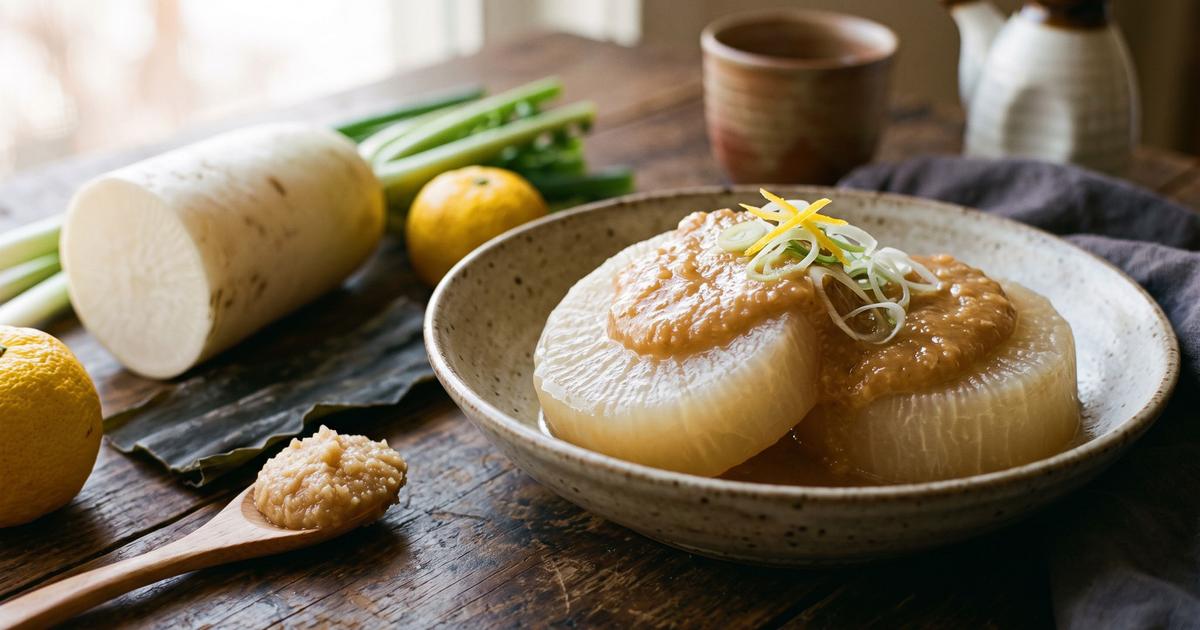
Furofuki daikon is winter comfort food in Japan, a thick round of daikon simmered until it is soft enough to cut with chopsticks and crowned with a spoon of warm, sweet miso. The name evokes blowing on something too hot to eat, which tells you how it is meant to be served. The daikon cooks in nothing but a gentle kombu dashi, turning translucent and mellow, while the topping does the seasoning. Here the sweet miso is loosened with a mashed date rather than the usual sugar and mirin, and ground sesame rounds it out. The miso is the only salt in the dish, so a thin, glossy layer is enough.
Ingredients
- 1 1/2 lb Daikon radish, about 680 g, cut into 1.5-inch (4 cm) thick rounds and peeled
- 1 piece Kombu, 4-inch (10 cm) square
- 2 tbsp White miso
- 1 piece Medjool dates, pitted, mashed with 2 tbsp (30 ml) hot water into a paste
- 1 tsp Sesame seeds, toasted, then ground
Method
- Peel the daikon rounds thickly, bevel the sharp top edge of each, and score a shallow cross into one flat face. Beveling keeps the edges from crumbling in the long simmer, and the cross-cut lets heat and dashi reach the center so the rounds cook through evenly.
- Steep the kombu in a pot with 4 cups (950 ml) cold water for 10 minutes, add the daikon, and bring it slowly to a bare simmer, lifting the kombu out just before it boils. A gentle steeping draws savory depth from the kombu, while boiling it would turn the broth slippery and bitter.
- Simmer the daikon quietly for 30 to 35 minutes until a skewer passes through with no resistance and the rounds look translucent. Daikon is watery and sharp when raw and only becomes sweet, soft, and faintly glassy after this slow cook, so give it the full time.
- Warm the white miso, date paste, and a spoonful of the hot dashi in a small pan with the ground sesame until glossy, then spoon it over the drained daikon. The daikon itself is unsalted; a thin layer of this sweet miso is all the seasoning each round needs, so use it lightly.
Nutrition
Estimated per serving: 70 calories, 3 g protein, 3 g fiber, 210 mg sodium. Computed from USDA FoodData Central reference values for the main ingredients. This is an approximation, not a laboratory measurement. How these are computed.
Cost per serving is estimated from US national-average retail prices for cheap staple forms, using BLS dried-bean prices and USDA produce prices. Prices vary by store and season, so treat it as a guide, not a receipt. How this is computed.