Chorchori, Bengali Mixed Vegetables with Panch Phoron
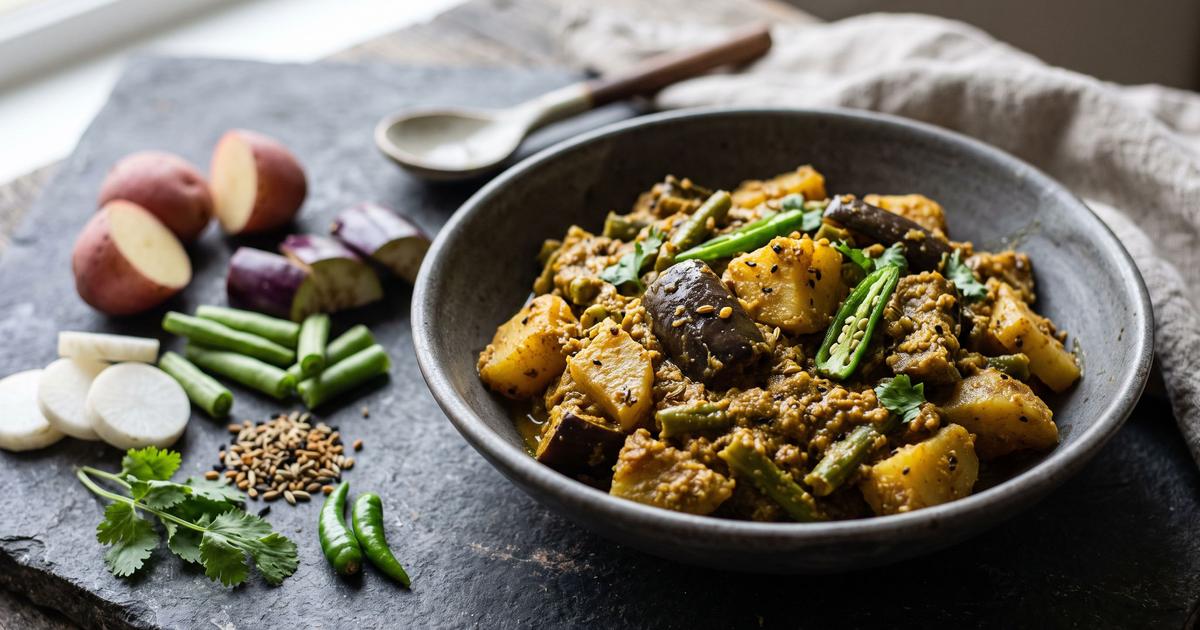
Chorchori is the Bengali answer to a crisper drawer with a little of everything in it: a dry, spiced tangle of whatever vegetables are on hand, bound by the two things that make it unmistakably Bengali, panch phoron and mustard. The vegetables go in staggered so the potato cooks through while the radish still has snap, and the ground mustard is stirred in at the very end, where its pungency reads as richness. It is humble, coconut-free by nature, and endlessly variable. Treat the vegetables here as a template and swap in what your week gives you.
Ingredients
- 1/2 lb Potatoes, cut in thin batons
- 1/2 lb Eggplant, cut in thin batons
- 1 cup Green beans, cut in 2-inch lengths
- 1 cup Radishes, cut in wedges
- 1 tsp Panch phoron
- 1 tsp Brown mustard seed
- 1/2 tsp Turmeric
- 2 wholes Indian green chile, slit
- 1 tbsp Ginger, grated
- 3 tbsp Cilantro, chopped
Method
- Grind the brown mustard seed with 2 tablespoons (30 ml) water to a coarse paste and set it aside. Ground mustard is the Bengali signature here, and its sinus-clearing pungency does the work that coconut or cream would in other regions.
- Warm a wide dry pan over medium heat and add the panch phoron. When the seeds crackle and smell nutty, about 40 seconds, add the ginger and slit chiles with a splash of water.
- Add the vegetables in order of how long they take: potatoes first, then eggplant, then green beans and radish, tossing each with the turmeric. Adding them in stages means nothing turns to mush while the potato finishes.
- Pour in 0.5 cup (120 ml) water, cover, and steam 15 minutes, stirring once, until everything is fork-tender and the water has nearly cooked away. A chorchori is meant to be dry, not saucy.
- Stir in the mustard paste and cook 2 minutes uncovered. Add it late: boiled long, ground mustard turns bitter, so it goes in only to bloom, not to simmer. Finish with cilantro and serve with rice.
Nutrition
Estimated per serving: 130 calories, 4 g protein, 6 g fiber, 40 mg sodium. Computed from USDA FoodData Central reference values for the main ingredients. This is an approximation, not a laboratory measurement. How these are computed.
Cost per serving is estimated from US national-average retail prices for cheap staple forms, using BLS dried-bean prices and USDA produce prices. Prices vary by store and season, so treat it as a guide, not a receipt. How this is computed.