Semoule au Lait, French Semolina Breakfast
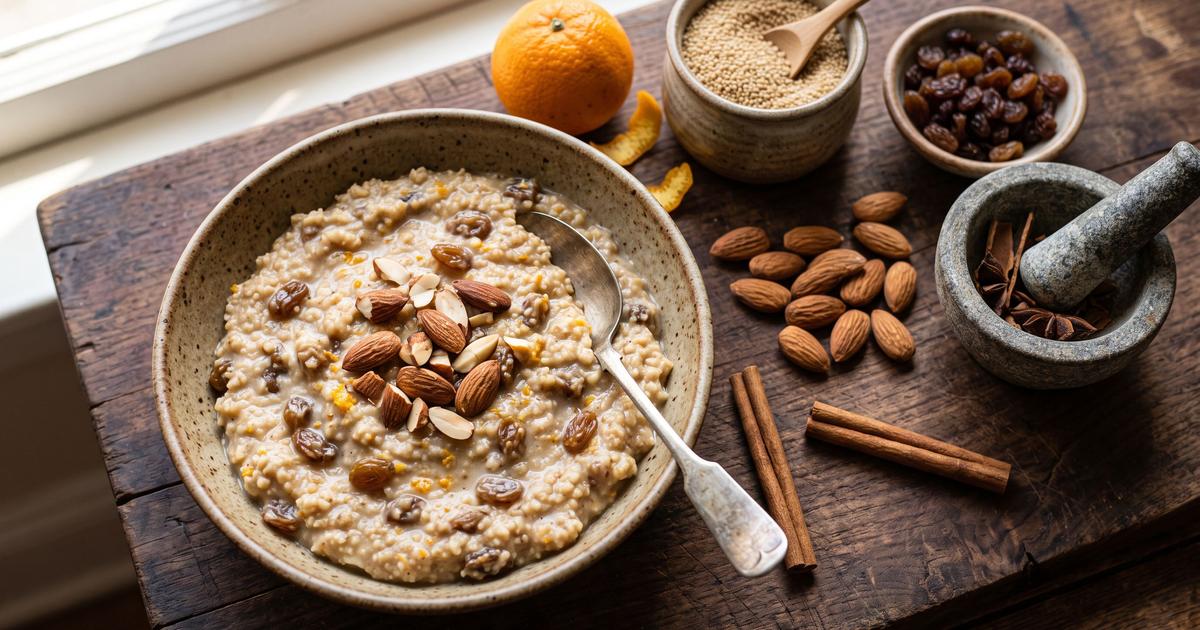
Semoule au lait is the semolina milk porridge French children grow up on, somewhere between breakfast and dessert and usually sweetened with plenty of sugar. Made with whole wheat couscous in place of refined semolina, it keeps the quick, comforting texture while trading empty starch for a whole grain. Dates blended into the milk carry the sweetness, and orange zest with a little cinnamon gives it the perfume that keeps it from tasting plain. It comes together in the time it takes the couscous to swell, which is barely any time at all, and it is just as good cold from the fridge the next morning as it is warm from the pot.
Ingredients
- 3/4 cup Whole wheat couscous
- 2 1/2 cups Unsweetened soy milk
- 3 wholes Medjool dates, pitted
- 1 Orange, zested, then 2 tbsp juice
- 1/4 tsp Ceylon cinnamon
- 1/3 cup Raisins
- 1/4 cup Almonds, toasted and chopped
Method
- Blend the pitted dates with about a quarter cup (60 ml) of the soy milk until smooth. Sweetening the milk itself, rather than the finished pot, spreads the sweetness evenly through a porridge that has no sugar to fall back on.
- Pour the date milk and the rest of the soy milk into a pot with the orange zest and cinnamon and bring it to a gentle simmer. Rain in the couscous while whisking. Whole wheat couscous is really tiny pasta and it swells fast, so keep whisking to keep it smooth.
- Cook just 3 to 5 minutes on low, stirring, until it thickens to the texture of loose porridge. It sets further off the heat, so pull it while it still looks slightly too loose, or it will be stiff by the time it reaches the bowl.
- Off the heat, stir in the orange juice and the raisins. Adding the juice at the end keeps its brightness, and the raisins soften in the residual heat without turning to mush.
- Spoon into bowls and top with the toasted almonds. Cold from the fridge it firms into something closer to a set pudding, which is its own reward; loosen it with a splash of soy milk if you want it pourable again.
Nutrition
Estimated per serving: 230 calories, 8 g protein, 4 g fiber, 70 mg sodium. Computed from USDA FoodData Central reference values for the main ingredients. This is an approximation, not a laboratory measurement. How these are computed.
Cost per serving is estimated from US national-average retail prices for cheap staple forms, using BLS dried-bean prices and USDA produce prices. Prices vary by store and season, so treat it as a guide, not a receipt. How this is computed.