Pruneaux Fourrés, Stuffed Agen Prunes
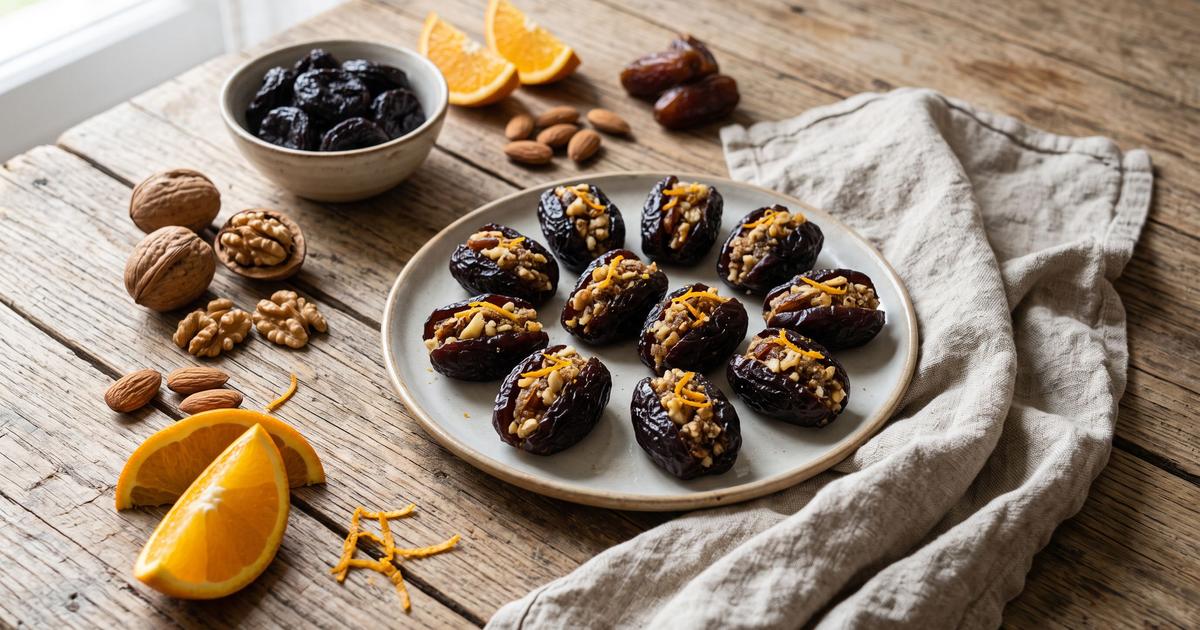
The Agen prune, grown along the Lot and Garonne rivers, is the pride of southwest France, and one of its oldest sweets is the pruneau fourré, a prune split and packed with a smooth almond or fruit paste. The traditional filling is almonds ground with a great deal of sugar; here toasted walnuts and almond flour supply the body while blended dates sweeten and bind it, and orange zest lifts the whole thing. The result is a dense, rich bite that eats like a proper confection, no baking required. Prunes bring real fiber and sorbitol along with their sweetness, so a couple with coffee is a satisfying end to a meal rather than a sugar spike.
Ingredients
- 18 wholes Prunes
- 1/2 cup Walnuts, toasted
- 1/4 cup Almond flour
- 2 wholes Medjool dates, pitted
- 1 Orange, zested, then 1 tbsp juice
- 1/4 tsp Ceylon cinnamon
Method
- If the prunes are firm, cover them with hot water for 5 minutes and pat them dry. Supple prunes fold around the filling without tearing, where dry ones crack, so plump them if they need it.
- Toast the walnuts in a dry pan for 4 minutes until fragrant, then let them cool. Toasting deepens their flavor and drives off the raw edge that would otherwise dominate such a small filling.
- Grind the walnuts, almond flour, pitted dates, orange zest, orange juice, and cinnamon in a food processor to a thick, moldable paste. The dates bind it and sweeten it at once, doing the job of the sugar and glucose syrup a classic pruneau fourré paste is built on.
- Slit each prune along one side, open it like a book, and press in about a teaspoon of paste, mounding it slightly proud of the fruit. Working the paste in firmly is what keeps the halves from falling apart when they are picked up.
- Chill the stuffed prunes for at least 30 minutes to firm the filling before serving. They keep in a tin for a week, which makes them a standing petit four to have on hand for coffee or the end of a meal.
Nutrition
Estimated per serving: 150 calories, 3 g protein, 4 g fiber, 5 mg sodium. Computed from USDA FoodData Central reference values for the main ingredients. This is an approximation, not a laboratory measurement. How these are computed.
Cost per serving is estimated from US national-average retail prices for cheap staple forms, using BLS dried-bean prices and USDA produce prices. Prices vary by store and season, so treat it as a guide, not a receipt. How this is computed.