Spiced Candied Walnuts
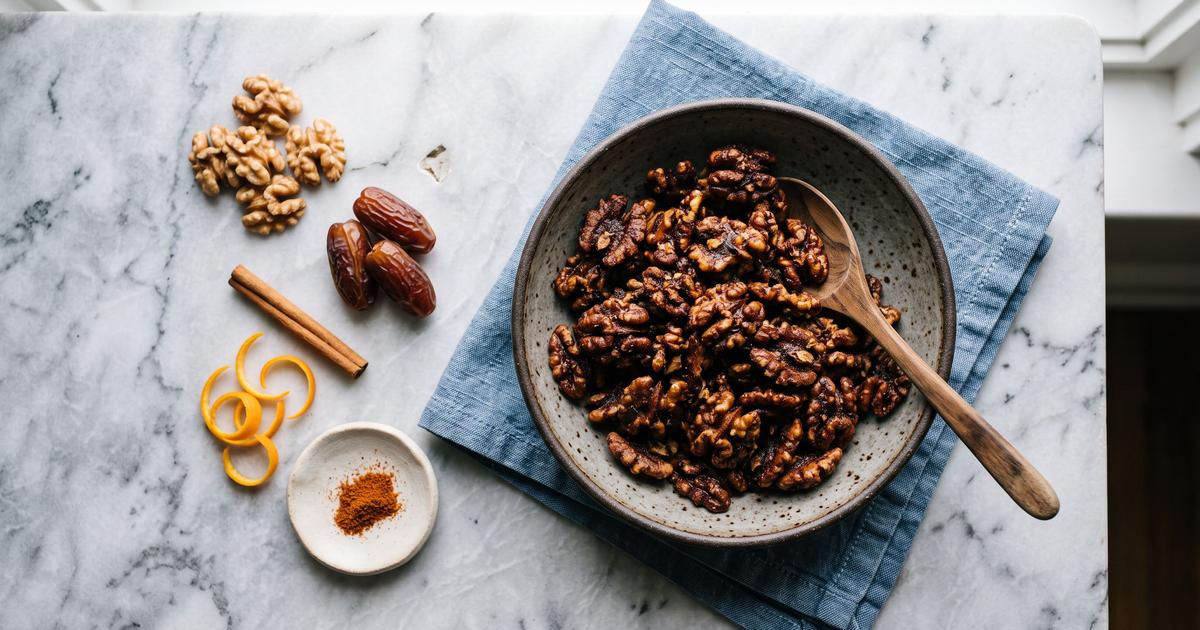
Every American holiday table has a bowl of candied or spiced nuts on it somewhere, usually glazed in sugar and often fried in butter. Neither is necessary. Blended dates make a glaze that caramelizes and crisps in a low oven, orange zest and cinnamon give it the seasonal warmth, and a quarter teaspoon of cayenne turns it into the sweet-and-hot version that is hard to stop eating. Ground flaxseed thickens the coating so it sets into a shell rather than running off the nuts. The only thing to watch is the heat: keep it low, because dates scorch and turn bitter well before sugar would. Roast, cool completely so they crisp, and store airtight for a week.
Ingredients
- 2 cups Walnuts
- 4 wholes Medjool dates, pitted
- 1 whole Oranges, zested
- 1 tsp cassia cinnamon
- 1/4 tsp Cayenne
- 1 tbsp Ground flaxseed
Method
- Blend the pitted dates with 3 tablespoons hot water and the orange zest into a smooth, pourable paste. Date paste is the glaze here: it caramelizes in the oven the way a sugar syrup would, but with the fruit's fiber left in and no refined sugar added.
- In a bowl, toss the walnuts with the date paste, cinnamon, cayenne, and ground flaxseed until every nut is coated. The flax thickens the glaze so it clings in a shell instead of sliding off, and the cayenne is what turns sweet nuts into the sweet-hot kind that disappears from a bowl.
- Spread the nuts in a single layer on a parchment-lined sheet and roast at 300F (150C), stirring every 8 minutes, until the coating looks dry and set and the kitchen smells toasted, about 20 minutes. Low and slow lets the glaze dry to a crackle without scorching the dates, which turn bitter if they catch.
- Cool the nuts completely on the sheet before breaking them apart. Warm, the coating is tacky; as it cools it hardens to a shatter, which is the whole point of a candied nut.
Nutrition
Estimated per serving: 200 calories, 5 g protein, 3 g fiber, 5 mg sodium. Computed from USDA FoodData Central reference values for the main ingredients. This is an approximation, not a laboratory measurement. How these are computed.
Cost per serving is estimated from US national-average retail prices for cheap staple forms, using BLS dried-bean prices and USDA produce prices. Prices vary by store and season, so treat it as a guide, not a receipt. How this is computed.