Baked Parippu Vadai
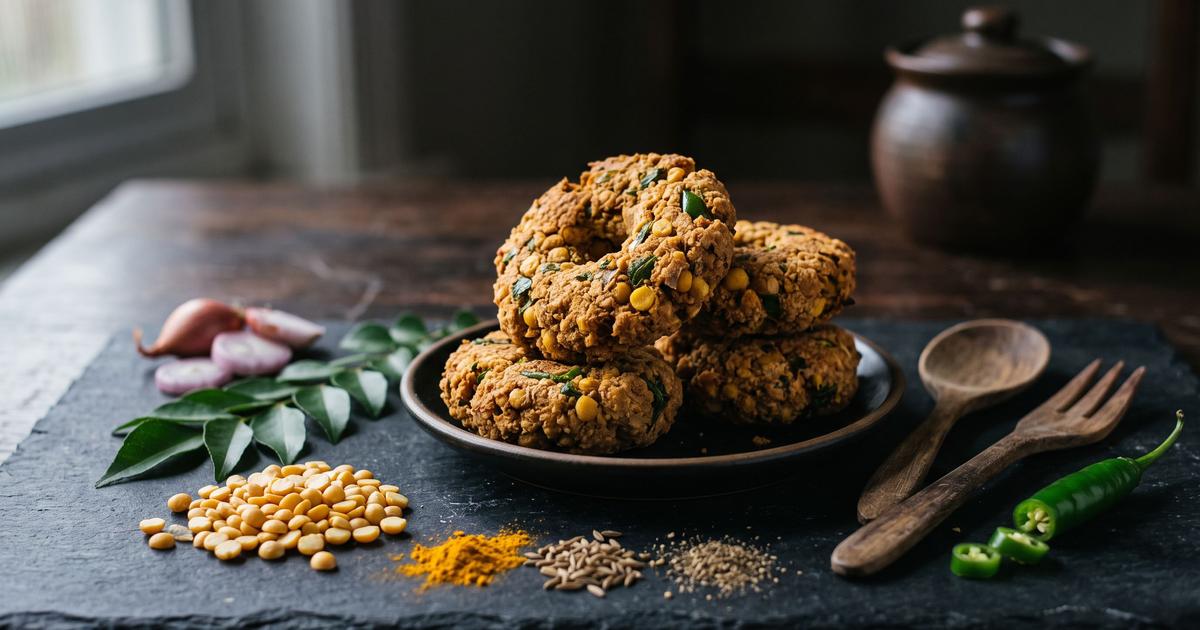
Parippu vadai are the split pea fritters piled in glass cases at Sri Lankan tea stalls and railway platforms, craggy and deep gold. They are traditionally deep fried, which is also the only part that breaks the rules here. Soaked split peas ground coarse release enough starch to hold together on their own, so a hot oven can do what the oil pot usually does: crisp the outside and cook the dense, fennel-scented middle. No egg, no flour, no salt. A squeeze of lime and the curry leaf carry the finish.
Ingredients
- 1 cup Yellow split peas, soaked 3 hours, drained
- 1/2 whole Yellow onions, finely chopped
- 12 Curry leaves, chopped
- 2 wholes Indian green chile, minced
- 1 tbsp Ginger, grated
- 1 tsp Fennel seed, coarsely crushed
- 1/2 tsp Cumin seed
- 1/4 tsp Cayenne
- 1/2 tsp Black peppercorns, ground
- 1 tbsp Lime juice
Method
- Drain the soaked split peas well. Set aside about 3 tablespoons of them whole, then grind the rest to a coarse, thick paste with no added water. The dry grind matters twice over: the starch the peas release is the only binder, so no egg or flour is needed, and the reserved whole peas give the finished vadai its signature bite.
- Mix the ground paste with the reserved whole peas, onion, curry leaves, chile, ginger, crushed fennel, cumin, cayenne, and pepper. Fennel is the aroma that says vadai, so keep it coarse enough to notice.
- Scoop portions and press each into a flat disc about 2.5 inches (6 cm) across and a half inch (1 cm) thick, so the middle cooks through before the edge hardens. You should get about a dozen.
- Bake on a lined tray at 425 F (220 C), flipping once, until firm and browned on both sides, 22 to 25 minutes. Deep frying is the tradition, but a hot dry oven crisps the outside and sets the middle without a pan of oil. The edges will be craggy and crunchy, the center dense and savory.
- Squeeze lime over the hot vadai and eat them as is or with tamarind date chutney. With no salt, the lime and the toasted fennel and curry leaf are what make each one taste seasoned.
Nutrition
Estimated per serving: 190 calories, 12 g protein, 9 g fiber, 15 mg sodium. Computed from USDA FoodData Central reference values for the main ingredients. This is an approximation, not a laboratory measurement. How these are computed.
Cost per serving is estimated from US national-average retail prices for cheap staple forms, using BLS dried-bean prices and USDA produce prices. Prices vary by store and season, so treat it as a guide, not a receipt. How this is computed.