Khao Tang, Thai Toasted Rice Crackers
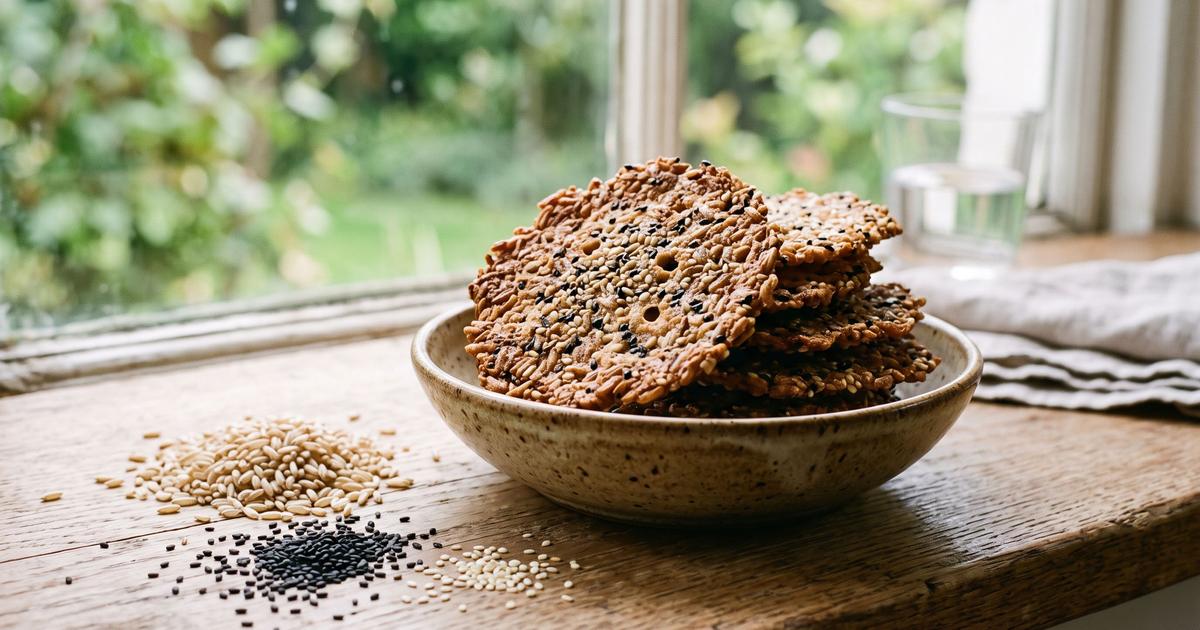
Khao tang is the crisp rice cracker Thai cooks traditionally made from the sheet of rice left stuck to the bottom of the pot, then deep-fried and served under a dip. This version skips the fryer entirely: a thin sheet of sticky brown rice is dried slow and low, then blasted hot at the end to shatter-crisp, so the only ingredients are whole grain and sesame. Short-grain brown rice matters because its natural stickiness holds the sheet together with no oil and no flour to bind it. Break the cooled sheet into shards and serve them with any of the nam prik chile dips, or eat them plain as a light, cheap, gluten-free snack. Kept airtight they last a week, and a short reheat brings the crunch back if the air has softened them.
Ingredients
- 1 cup short grain brown rice, rinsed
- 2 tbsp Sesame seeds
Method
- Cook the rice with 2 cups (475 ml) water until soft and sticky, about 40 minutes, then let it steam off the heat for 10. Short-grain brown rice is the right choice because its stickiness is what binds the cracker; a drier long-grain rice will crumble.
- While the rice is warm, fold in the sesame seeds and press the rice into a thin, even sheet, about 1/8 inch (3 mm), on a parchment-lined tray. Wet your hands or a spatula so it does not stick, and keep the thickness uniform so every piece crisps at the same rate.
- Score the sheet into squares, then dry it in a 250F (120C) oven for 35 to 40 minutes until stiff and no longer tacky. The low heat drives out moisture without browning, which is what lets the cracker turn brittle rather than chewy.
- Raise the heat to 400F (200C) for a final 5 to 8 minutes, watching closely, until the squares are golden and shatter-crisp. Cool completely before storing airtight; they go soft in humid air, so crisp them again for a few minutes if they soften.
Nutrition
Estimated per serving: 130 calories, 3 g protein, 2 g fiber, 5 mg sodium. Computed from USDA FoodData Central reference values for the main ingredients. This is an approximation, not a laboratory measurement. How these are computed.
Cost per serving is estimated from US national-average retail prices for cheap staple forms, using BLS dried-bean prices and USDA produce prices. Prices vary by store and season, so treat it as a guide, not a receipt. How this is computed.