Ensalada Malagueña
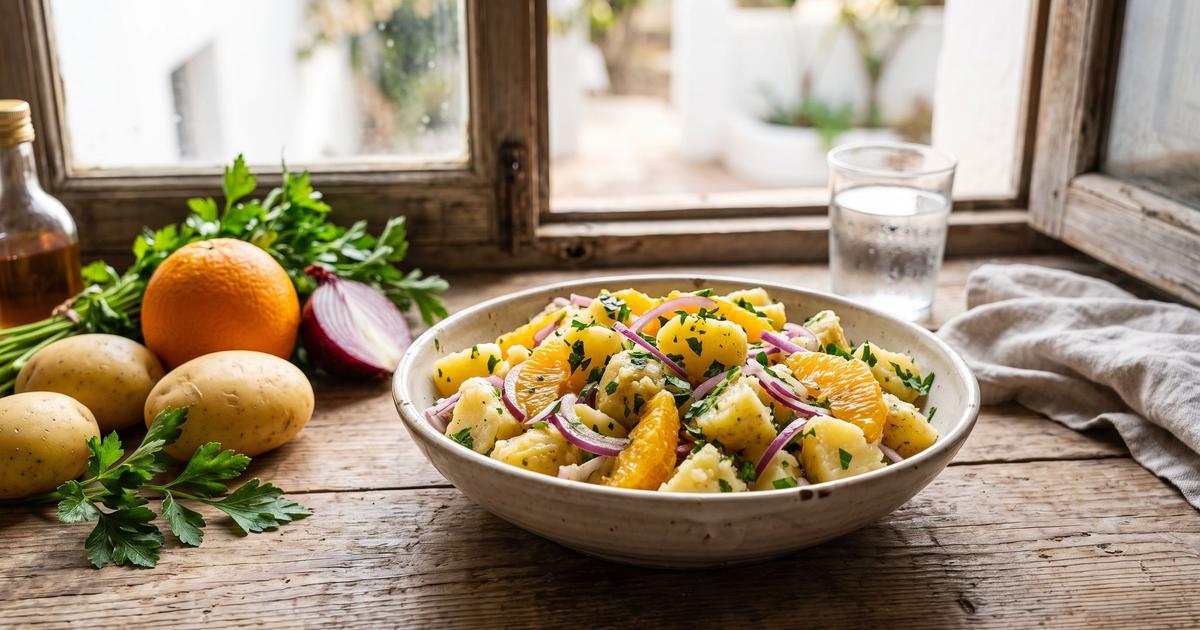
On the coast around Málaga, potato and orange land in the same bowl in a salad that sounds unlikely and works completely. The classic version is dressed up with soaked salt cod and cured olives, but at its heart it is boiled potato, sweet orange, sharp raw onion, and good vinegar, and that core needs neither the fish nor the salt. Sherry vinegar, Andalusia's own, does double duty: it tames the onion and then becomes the dressing, joined by the juice caught from segmenting the oranges. Cooking the potatoes in their skins keeps them firm, and everything is folded gently so the orange stays in pieces. It is a bright, cheap summer plate that only gets better as it sits.
Ingredients
- 1 lb Potatoes, boiled whole, then cubed
- 2 wholes Oranges, peeled and segmented
- 1/2 whole Red onions, slivered
- 1/3 cup Flat-leaf parsley, chopped
- 2 tbsp Sherry vinegar
- 1/2 tsp Black peppercorns, freshly ground
Method
- Boil the potatoes whole in their skins until a knife slides through easily, about 20 minutes, then cool, peel, and cut into rough cubes. Cooking them whole keeps them from waterlogging, so they stay firm enough to hold their shape in the salad.
- Soak the slivered red onion in the sherry vinegar while the potatoes cool. The vinegar mellows the onion and, once it has done that job, becomes the dressing, so nothing is wasted and no oil is needed.
- Peel the oranges down to the flesh and cut the segments free over the bowl to catch the juice. That juice is half the dressing: sweet, faintly bitter, and bright enough to make salt beside the point.
- Add the potato cubes, orange segments, and parsley to the onion and vinegar, grind in the black pepper, and fold gently so the oranges do not break apart. Let it rest 10 minutes for the flavors to meet.
- Serve cool. Traditionally this carries flaked salt cod and olives; left out, the potato and orange stand on their own, and the salad stays light and clean.
Nutrition
Estimated per serving: 160 calories, 4 g protein, 5 g fiber, 25 mg sodium. Computed from USDA FoodData Central reference values for the main ingredients. This is an approximation, not a laboratory measurement. How these are computed.
Cost per serving is estimated from US national-average retail prices for cheap staple forms, using BLS dried-bean prices and USDA produce prices. Prices vary by store and season, so treat it as a guide, not a receipt. How this is computed.