British Pub-Style Pickled Onions
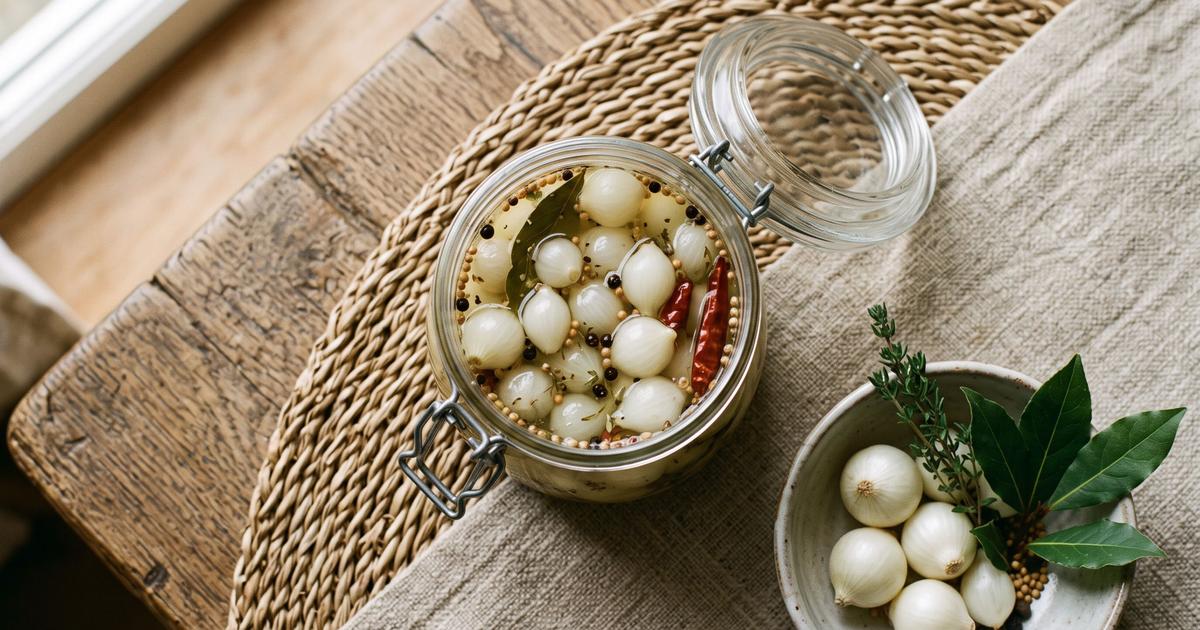
Pickled onions are the sharp crunch on a ploughman's plate, the thing that cuts a wedge of cheese or a heap of beans. The shop version is preserved in salt and malt vinegar for the long haul, but if you are willing to keep the jar in the fridge and eat it within a few weeks, you can skip the salt entirely and lose nothing but the shelf life. Blanch the onions to loosen their skins and soften their raw edge, pack them tight, and cover them with cider vinegar you have warmed with the classic spicing of bay, allspice, mustard seed, and chile. A mashed date replaces the spoon of sugar in a sweet pickle. Give it three days for the onions to take on the spice. Serve alongside a bean salad, a jacket potato, or a slice of dark bread.
Ingredients
- 1 1/2 lb Yellow onions, small, peeled whole
- 2 cups Apple cider vinegar
- 2 wholes Medjool dates, pitted
- 2 wholes Bay leaves
- 1 tsp Yellow mustard seed
- 6 wholes Allspice
- 1 tsp Black peppercorns
- 1/2 tsp Red pepper flakes
Method
- Drop the peeled onions into a bowl of just-boiled water for one minute, then drain. This loosens the skins for easy peeling and takes the raw bite off the surface, the step that keeps a jar of pickled onions from being harshly sulfurous.
- Pack the onions tightly into a clean jar. Small pickling onions are traditional, but a large yellow onion cut into thick wedges pickles just as well and costs less.
- Warm the vinegar with the bay, mustard seed, allspice, peppercorns, and chile flakes until it steams but does not boil, then mash in the dates and stir until dissolved. Gentle heat pulls the spices into the vinegar, and the date stands in for the pinch of sugar a sweet pickle usually carries.
- Pour the hot spiced vinegar over the onions to cover, let it cool, then cap and refrigerate at least 3 days before eating. The pub jar is brined in salt and keeps for months on a shelf; this salt-free version is a fridge pickle instead, sharp and crisp, best within three weeks.
Nutrition
Estimated per serving: 25 calories, 1 g protein, 1 g fiber, 6 mg sodium. Computed from USDA FoodData Central reference values for the main ingredients. This is an approximation, not a laboratory measurement. How these are computed.
Cost per serving is estimated from US national-average retail prices for cheap staple forms, using BLS dried-bean prices and USDA produce prices. Prices vary by store and season, so treat it as a guide, not a receipt. How this is computed.