Salsa Verde, European Caper and Parsley Sauce
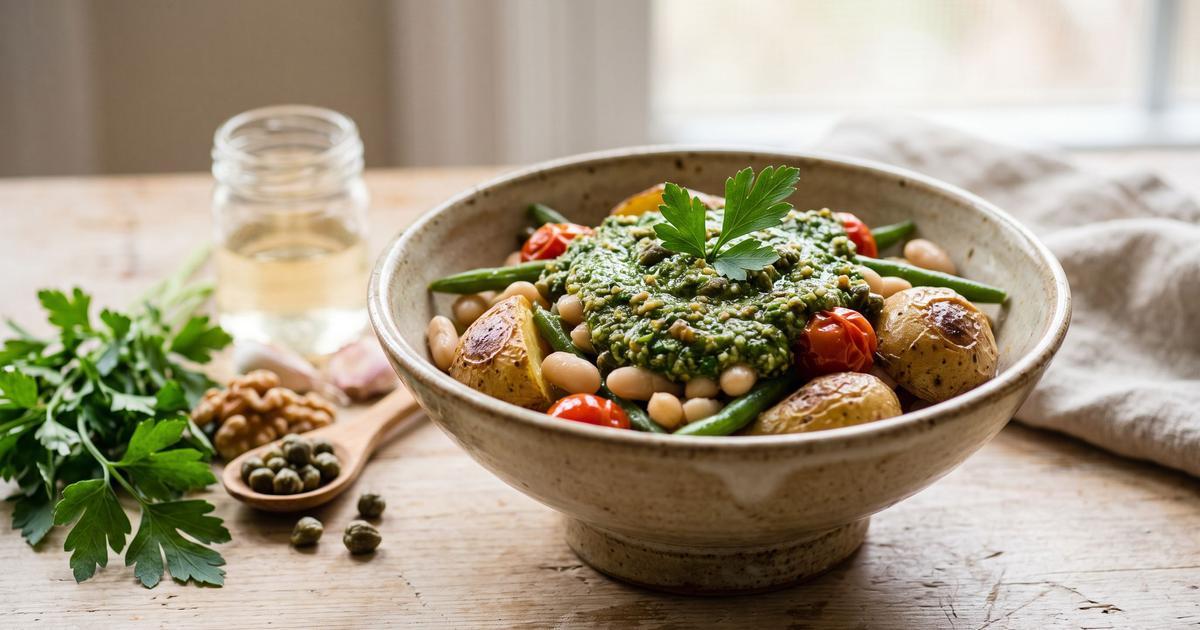
Salsa verde travels the whole northern Mediterranean and up into France under different names, always the same idea: a raw green sauce, sharp with capers and vinegar, that wakes up anything plain. The classic is bound with a great deal of olive oil and sometimes soaked bread. Neither is necessary. A small handful of walnuts, chopped in with the herbs, gives the sauce its body and richness, and a teaspoon of mustard emulsifies it so it clings. Rinse the capers to tame their salt, since they and the mustard are the only salt in the bowl and there is no reason to add more. Keep it loose enough to spoon. It transforms a plate of white beans, boiled potatoes, roasted cauliflower, or grilled vegetables, and it takes ten minutes.
Ingredients
- 2 cups Flat-leaf parsley, packed leaves
- 2 tbsp Capers, rinsed
- 1 clove Garlic
- 3 tbsp Walnuts
- 1 tsp Dijon mustard
- 2 tbsp Red wine vinegar
- 1 tbsp Lemon juice
- 1/4 tsp Black peppercorns, freshly ground
Method
- Rinse the capers hard under cold water and press them dry. They carry the sauce's salt, so a quick rinse pulls off the excess brine and leaves you their floral, briny snap without swamping the herbs. This is a salt-light sauce by design: the capers and the mustard are the salt.
- Chop the parsley, garlic, capers, and walnuts together on a board until fine, or pulse them in short bursts. The walnuts are the trick that lets this sauce skip the usual river of olive oil: ground fine, they give it body and a soft richness of their own.
- Scrape it into a bowl and stir in the mustard, red wine vinegar, lemon, and pepper. The mustard binds the sauce the way an emulsion of oil normally would, pulling the acid and the solids into one spoonable green.
- Loosen with 1 to 2 tbsp water (15 to 30 ml) until it drops easily from a spoon. Let it stand 10 minutes for the flavors to marry. It keeps two days in the fridge, though the green fades, so make it close to when you will use it.
Nutrition
Estimated per serving: 60 calories, 2 g protein, 1 g fiber, 110 mg sodium. Computed from USDA FoodData Central reference values for the main ingredients. This is an approximation, not a laboratory measurement. How these are computed.
Cost per serving is estimated from US national-average retail prices for cheap staple forms, using BLS dried-bean prices and USDA produce prices. Prices vary by store and season, so treat it as a guide, not a receipt. How this is computed.