Che Kho, Vietnamese Sweet Mung Bean Pudding
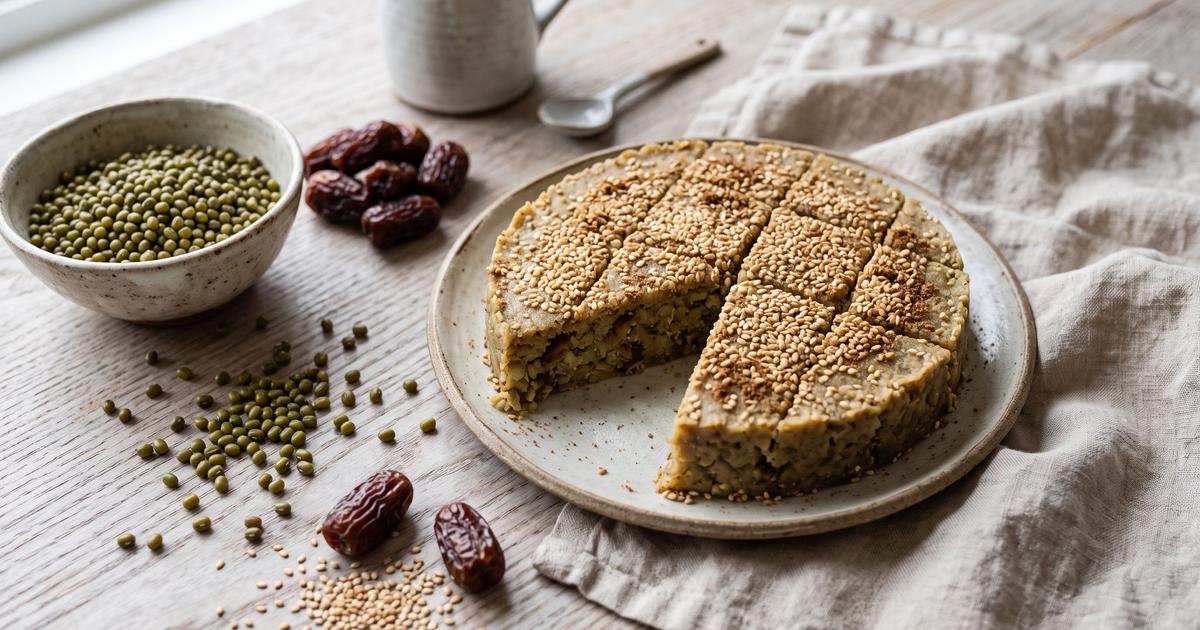
Che kho is the firm sweet mung bean pudding traditionally made for Tet, the Vietnamese lunar new year, cut into small diamonds and dusted with toasted sesame. Most sweet che are soupy; che kho is the exception, cooked down until it is dense enough to slice and keep for days. The trick is patience at the stove: the paste has to be stirred until enough water cooks off that it will set on its own as it cools. Dates carry all the sweetness, so no sugar is needed, and it is naturally coconut-free.
Ingredients
- 1 1/2 cups Mung beans, hulled split (moong dal), soaked 2 hours and drained
- 6 Medjool dates, pitted, blended smooth with 1 cup (240 ml) water
- 2 tbsp Sesame seeds, toasted
Method
- Put the soaked mung beans in a pot with 3 cups (720 ml) water. Bring to a boil, then cover and simmer 20 to 25 minutes, until the beans are completely soft and most of the water is gone. They have to be tender enough to crush with no resistance, because the whole texture depends on them mashing smooth.
- Mash the hot beans to a thick paste with the back of a spoon, or blend them briefly. A smooth paste is what separates che kho from a loose porridge.
- Stir in the blended dates and cook over low heat, stirring almost constantly, for 8 to 12 minutes. The paste will thicken and start to pull away from the sides of the pot. Constant stirring keeps the bottom from scorching, and cooking off the moisture now is what lets the pudding set firm later. It is thick enough when a spoon dragged across the bottom leaves a clean line that holds.
- Scrape the paste into a small pan or dish and press it flat and even, about 1 inch (2.5 cm) thick. Let it cool completely, at least 30 minutes, during which it firms into a sliceable block.
- Turn it out, cut into small diamonds or squares, and press toasted sesame seeds onto the tops. The sesame gives the nutty crunch and the finish that mark the classic Tet version. It keeps, covered in the refrigerator, for a week.
Nutrition
Estimated per serving: 190 calories, 8 g protein, 6 g fiber, 10 mg sodium. Computed from USDA FoodData Central reference values for the main ingredients. This is an approximation, not a laboratory measurement. How these are computed.
Cost per serving is estimated from US national-average retail prices for cheap staple forms, using BLS dried-bean prices and USDA produce prices. Prices vary by store and season, so treat it as a guide, not a receipt. How this is computed.