Carottes Râpées, French Grated Carrot Salad
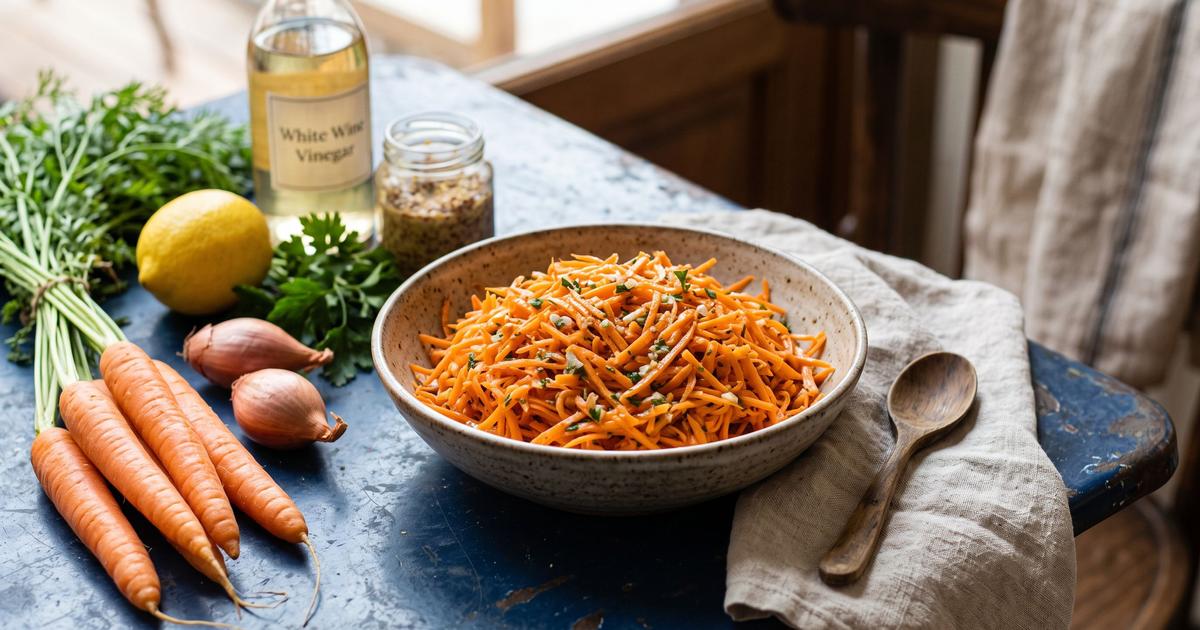
Carottes râpées is the grated carrot salad that sits in every French traiteur window and school canteen, the plainest and most reliable of the crudités. Its whole character comes from the dressing, and the classic dressing leans on oil. Dijon mustard makes that unnecessary: whisked with white wine vinegar, lemon, and a little water, it emulsifies into something that coats the carrots and tastes bright and sharp on its own. Shallot and parsley are the traditional additions, and a rest in the fridge is what turns a bowl of raw carrot into a proper salad. It is about as cheap and quick as food gets, and it keeps for a couple of days, improving overnight.
Ingredients
- 1 lb Carrots, peeled and grated
- 1 tsp Dijon mustard
- 1 tbsp White wine vinegar
- 1 tbsp Lemon juice, fresh
- 1 Shallot, minced
- 1/4 cup Flat-leaf parsley, chopped
- 1/4 tsp Black peppercorns, freshly ground
Method
- Grate the carrots on the coarse side of a box grater or the shredding disc of a food processor. Grated, not sliced, is what defines this salad: the fine shreds hold the dressing in a way that chunks never would.
- In a bowl big enough for the carrots, whisk the mustard, vinegar, and lemon juice together with a spoon of water until it thickens and turns cloudy. The mustard is an emulsifier, so it pulls the acid and water into a dressing that clings to the carrot the way an oil vinaigrette would, with none of the oil.
- Add the minced shallot to the dressing and let it sit a minute. The acid takes the raw bite off the shallot and lightly pickles it, which is gentler than raw onion in a delicate salad.
- Toss the grated carrot and parsley through the dressing until every shred is coated, then grind in the black pepper. Toss well, because an evenly dressed carrot is what makes this taste seasoned without salt.
- Let it rest at least 10 minutes before serving, or up to a day in the fridge. The carrots soften slightly and drink in the dressing as they sit, so it is better made ahead than at the last minute.
Nutrition
Estimated per serving: 70 calories, 2 g protein, 4 g fiber, 55 mg sodium. Computed from USDA FoodData Central reference values for the main ingredients. This is an approximation, not a laboratory measurement. How these are computed.
Cost per serving is estimated from US national-average retail prices for cheap staple forms, using BLS dried-bean prices and USDA produce prices. Prices vary by store and season, so treat it as a guide, not a receipt. How this is computed.