Peperonata, Italian Stewed Peppers
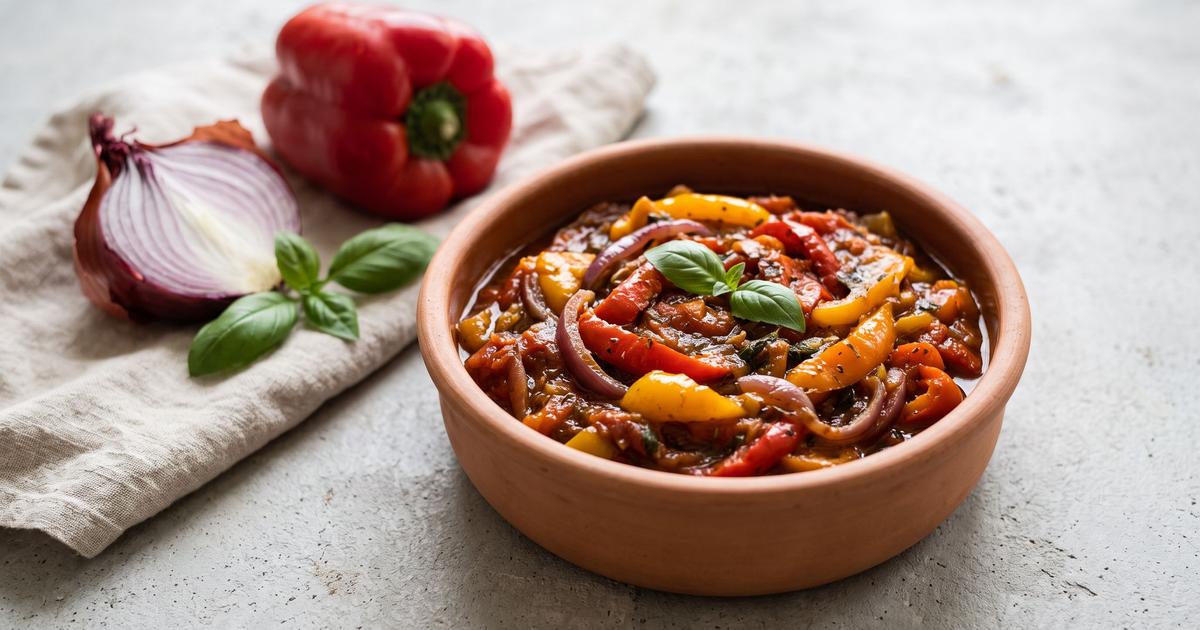
Peperonata is the Italian answer to a market table piled with peppers: cook them down slow with onion and tomato until they collapse into something between a side dish and a sauce. It sweetens entirely on its own as the peppers soften, which is why it needs no sugar and barely any seasoning beyond the vinegar that lifts it at the end. Cooked in water rather than oil it stays bright and clean instead of heavy. Spoon it next to anything, fold it through whole-grain pasta, or pile it on toast. Like most stewed vegetable dishes it improves overnight, so make a double batch and keep it in the fridge through the week.
Ingredients
- 3 Bell peppers, mixed red and yellow, sliced into strips
- 1 large Yellow onions, halved and sliced
- 3 cloves Garlic, sliced
- 1 cup Canned whole peeled tomatoes, crushed by hand
- 1 tbsp Red wine vinegar
- 1/4 cup Basil, torn
- 1 tsp Dried oregano
- 1/2 tsp Black peppercorns, ground
Method
- Sweat the onion in a wide pan with a splash of water over medium heat until soft and translucent, about 8 minutes, adding more water whenever the pan dries. You are building a sweet base, not browning it, so keep the heat gentle.
- Add the peppers and garlic and cook 10 minutes, stirring now and then. As the peppers give up their water they turn sweet and floppy, and that slow-drawn sweetness is what replaces any need for sugar or salt here.
- Stir in the crushed tomatoes and oregano, lower the heat, and let it stew uncovered 20 to 25 minutes until the peppers are silky and the sauce is thick and jammy. Rushing this leaves the peppers tasting raw and the sauce thin, so give it the time.
- Take the pan off the heat and stir in the red wine vinegar. A stew this sweet needs an acid to bring it into focus, the same job a splash of vinegar does in a Sicilian caponata.
- Fold in the torn basil and grind over the black pepper. Peperonata is best warm or at room temperature, and a night in the fridge deepens it, so it is worth making the day before.
Nutrition
Estimated per serving: 90 calories, 3 g protein, 5 g fiber, 55 mg sodium. Computed from USDA FoodData Central reference values for the main ingredients. This is an approximation, not a laboratory measurement. How these are computed.
Cost per serving is estimated from US national-average retail prices for cheap staple forms, using BLS dried-bean prices and USDA produce prices. Prices vary by store and season, so treat it as a guide, not a receipt. How this is computed.